
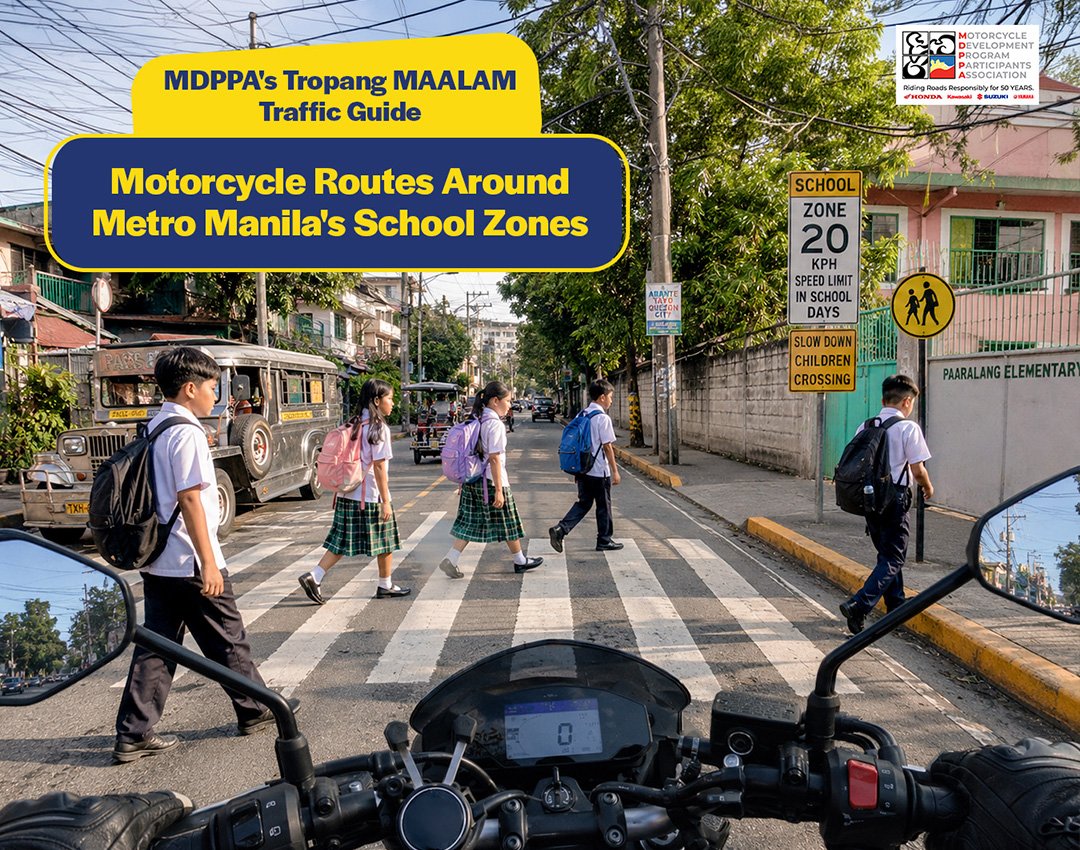
Navigating Metro Manila’s roads can be especially challenging around major schools and universities, where heavy traffic has become a daily reality throughout the academic year. According to the Metropolitan Manila Development Authority (MMDA), several school zones across the metropolis continue to experience recurring congestion, particularly during the morning and afternoon rush hours when students, employees, and commuters converge on the same corridors.
To help riders plan their trips more efficiently, the Motorcycle Development Program Participants Association (MDPPA) has put together this Tropang MAALAM traffic guide highlighting some of Metro Manila’s busiest school zones identified by the MMDA. Here are 11 congestion hotspots, along with alternative and bypass routes that motorcycle riders can use to keep their journeys safer, smoother, and more efficient.
Katipunan Avenue Cluster (Ateneo, Miriam, UP Diliman)
For motorcycle riders who simply want to get past Katipunan Avenue without being trapped in the congestion around Ateneo, Miriam, and UP Diliman, there are two practical bypasses that can make the ride smoother.
One of the most reliable detours is the Aurora Boulevard connector. Riders coming from Cubao or Marikina can slip onto Aurora near the LRT Katipunan Station. From here, they can reconnect further north at Balara or cut through Anonas and Boni Serrano. This route avoids the notorious Katipunan-Aurora intersection, though riders should be mindful of Aurora’s busy crossings.
Another strong option is C.P. Garcia Avenue. Instead of braving the school zone stretch of Katipunan, riders can divert toward C.P. Garcia, which leads directly into UP Diliman and onward to Commonwealth. This bypass is especially useful for those heading toward Quezon Memorial Circle, Philcoa, or the northern districts of Quezon City. It’s a smoother ride compared to staying on Katipunan’s main lanes.
Ortigas Avenue / Greenhills Cluster (La Salle Green Hills, Xavier, ICA, Poveda)
Ortigas Avenue is one of Metro Manila’s busiest corridors, and the Greenhills school zone makes it even tougher to cross during peak hours. Riders who aren’t stopping at La Salle Green Hills, Xavier, ICA, or Poveda can sidestep the congestion by choosing from several nearby streets.
If coming from San Juan or Mandaluyong, Wilson Street is the most practical parallel road. It runs alongside Ortigas Avenue and lets riders slip past the school cluster, rejoining Ortigas near Greenhills Shopping Center or continuing toward EDSA. The trade-off is narrower lanes and commercial activity, but it’s a dependable way to avoid the choke points.
If the destination is EDSA or Makati, Annapolis Street offers a direct connector. Riders can turn off Ortigas into Annapolis and emerge near the MRT station, bypassing the buildup around ICA and La Salle Green Hills. This route is short and efficient, though traffic enforcement is strict, so lane discipline is essential.
Inner roads like Eisenhower Street or Club Filipino Avenue also provide a quieter weave around the cluster.
Taft Avenue Cluster (DLSU, CSB, St. Scholastica, UP Manila)
If approaching from the south, riders can divert into Osmeña Highway. This parallel road runs alongside Taft and connects directly to Quirino Avenue and onward to Makati. It’s a faster option for those heading north without needing to pass the school gates, though riders should watch for trucks and buses that also use this corridor.
If going to Intramuros or the northern side of Manila, Roxas Boulevard provides a scenic alternative. Riders can slip out of Taft via Quirino Avenue and follow Roxas Boulevard along Manila Bay. This bypass avoids the school zone entirely and reconnects near Luneta or Anda Circle, making it ideal for those bound for the Port Area or Tondo.
San Andres Street also offers a useful connector for shorter detours. Riders can cut across from Taft to Osmena Highway or even toward Paco, sidestepping the bottleneck near DLSU and CSB. It’s narrower and more residential, but it works well for those familiar with Manila’s inner streets.
Riders can also use Leon Guinto Street as a parallel passage. Running behind St. Scholastica’s and Benilde, it allows motorcycles to weave past the school zone and reconnect to Quirino or Ocampo.
Intramuros Cluster (Mapua, Lyceum, Letran, PLM)
Riders approaching from the University Belt can swing toward Ayala Boulevard instead of heading straight into Padre Burgos. This detour lets them bypass the congestion near PLM and reconnect at Lawton or Luneta, keeping clear of the school gates.
Those bound for the northern districts, or the Port Area will find Roxas Boulevard a smoother ride. By slipping out via Kalaw Avenue, riders can follow the bayfront road and rejoin traffic near Anda Circle, avoiding the buildup around Mapua and Lyceum entirely.
Heading south, Quirino Avenue provides a link to Osmena Highway and Roxas Boulevard. This route funnels riders toward Pasay or Makati without forcing them through the Intramuros cluster.
U-Belt Sampaloc Core (UST, FEU, UE)
Riders coming from Espana toward Quezon Avenue can avoid the UST stretch by diverting into Lacson Avenue. This wide road runs along the eastern side of UST and connects directly to Nagtahan Bridge, offering a faster passage toward Sta. Mesa or Mandaluyong. It’s a cleaner ride compared to squeezing through Espana’s school-heavy lanes.
Those heading toward the northern districts can use Dapitan Street or A.H. Lacson to skirt the UST perimeter. These streets allow riders to bypass the core of the campus and reconnect with Quezon Avenue or Blumentritt without crossing the student-heavy España corridor.
For riders bound east, instead of weaving through Morayta and the FEU/UE cluster, riders can follow Recto straight toward Divisoria or C.M. Recto Bridge.
U-Belt Recto-Mendiola Core (San Beda, CEU, LCCM)
The most reliable alternative route for riders who want to avoid this cluster is the Dapitan-Fugoso corridor. Running along the northern edge of the University of Santo Tomas and parallel to Recto Avenue, this corridor lets riders slip past the U-Belt without passing through the busiest sections of Mendiola, Legarda, or the area surrounding San Beda University, Centro Escolar University, and nearby La Consolacion College Manila.
Fugoso links westward to Rizal Avenue, while Dapitan reconnects eastward toward Lacson Avenue or Quezon Boulevard. Narrower than Recto Avenue but well suited for motorcycles, it remains an effective way to keep moving when the U-Belt core becomes congested.
On the southern side, Concepcion Aguila Street provides a compact connector that skirts the Mendiola area. It links into Ayala Boulevard and Lawton, allowing riders to bypass the traffic generated by San Beda University, Centro Escolar University, and La Consolacion College Manila. This route is especially useful for those heading toward Intramuros or Luneta.
Meanwhile, Lerma Street offers a short but effective east to west connection between Quezon Boulevard and España Boulevard, allowing riders to avoid Recto Avenue’s busiest stretch while remaining close to the U-Belt road network.
Finally, riders familiar with Sampaloc can use Laong Laan Street or Dos Castillas Street as northern bypasses. These inner roads weave around the U-Belt before reconnecting to Lacson Avenue or Blumentritt Road, providing a quieter alternative when traffic builds around the university district.
Santa Mesa District (PUP Main Campus)
One of the most practical routes for bypassing this is Valenzuela Street. Running parallel to Pureza, it allows riders to slip past the campus and reconnect toward Nagtahan Bridge without plunging into the student-heavy zone.
There’s also P. Sanchez Street, which provides a cleaner link for those heading toward Mandaluyong or Makati. By diverting from Sta. Mesa into Sanchez, riders can cross Shaw Boulevard or connect to Kalentong, avoiding the bottleneck near PUP altogether.
Southbound riders bound for Pandacan can use Tayuman Street and nearby connectors to weave around the Sta. Mesa hub. This route funnels motorcycles toward Paco and Quirino Avenue, sidestepping the Pureza congestion.
Riders can also reroute via Old Sta. Mesa Street. It runs parallel to the main thoroughfare and reconnects near Nagtahan, offering a quieter passage when the transit hub is jammed.
Commonwealth-Batasan School Corridor (BHNHS, CES, CHS)
Commonwealth Avenue is wide, but near Batasan Hills National High School and the Commonwealth Elementary and High Schools, it slows to a crawl, so the trick is knowing when to stay on lane and when to slip off into the feeder roads.
North of the schools, IBP Road loops around the Batasan Complex and reconnects toward Litex or Payatas. It’s the classic bypass, letting riders swing wide without brushing against the school gates. Eastward, San Mateo Road offers a clean escape for those bound for Marikina or San Mateo.
Meanwhile, Magsaysay Avenue and the inner streets of Batasan Hills allow motorcycles to weave through the neighborhood and rejoin Commonwealth farther down, past the worst of the school strip.
Southbound riders often look to Capitol Hills Drive as a connector into Katipunan. It’s a smoother passage toward Diliman and UP, but Katipunan itself is a congestion zone, especially near Ateneo and Miriam. For motorcycles, Capitol Hills is still useful, but only if the destination lies closer to Katipunan or Diliman. Otherwise, staying on Commonwealth and slipping into inner streets may actually save time.
Rizal High School Zone (Pasig City)
Rizal High School sits close to C. Raymundo Avenue and within reach of Ortigas Avenue Extension. During school hours, jeepneys, tricycles, and private vehicles funnel into the area, creating a knot of congestion that can trap motorcycles if they stay on the main roads too long.
The key to moving through Pasig is knowing which river crossings and feeder roads to trust. Riders coming from Ortigas often slip into Dr. Sixto Antonio Avenue, a parallel corridor that avoids the heaviest stretch of C. Raymundo.
Those bound for C5 can divert into E. Rodriguez Jr. Avenue via Ortigas Extension, skirting the Rizal High bottleneck entirely. It’s a longer arc, but it keeps motorcycles flowing toward Libis.
Running parallel to C. Raymundo, Mercedes Avenue offers a dependable bypass that allows motorcycles to weave through residential areas and reconnect near the city center, past the school traffic.
Dr. Pilapil Street and nearby connectors, while narrower and not built for heavy vehicles, also gives motorcycles a way to slip around the congestion and rejoin the main arteries farther down.
Cubao Public School Hub (Ramon Magsaysay High School)
Ramon Magsaysay High School sits right in the middle of Aurora Boulevard, with EDSA and Araneta Center pressing in from all sides. For motorcycle riders, the challenge is not just the school traffic, but the way Cubao pulls vehicles from every direction.
Those coming from Quezon City often slip into New York Street or Ermin Garcia Avenue, weaving through residential blocks to reconnect with Aurora farther down. These inner streets are narrow, but they let riders bypass the heaviest stretch near the school.
From EDSA, riders can also divert into P. Tuazon Boulevard. It runs parallel to Aurora and skirts the Araneta Center, offering a cleaner passage toward Santolan or Marikina.
Eastbound riders going to Katipunan or Marikina often use Bonny Serrano Avenue. It’s longer, but it pulls motorcycles away from the Cubao knot and drops them closer to Camp Aguinaldo or Libis.
Riders who frequent Cubao also often turn to 15th Avenue and its nearby connectors, using these residential streets as a quieter way to slip around the hub and rejoin Aurora Boulevard or EDSA past the congestion.
Valenzuela Highway School Strip (Canumay East and Vicente P. Trinidad High Schools)
The most reliable tactic is to slip into MacArthur Highway early, using it as a parallel corridor that bypasses the school zone and reconnects toward Malinta or Meycauayan. Riders bound for Quezon City often divert into Mindanao Avenue, a cleaner link southward that avoids the Valenzuela bottleneck altogether.
For local weaving, Canumay Road and nearby connectors provide narrower but effective detours. These residential streets allow motorcycles to slip around the school gates and rejoin the highway farther down, past the congestion.
Eastbound riders heading toward Novaliches or Fairview can use General T. De Leon Road. It’s a longer arc, but it pulls motorcycles away from the school strip and drops them closer to the Quezon City boundary.
About MDPPA
The Motorcycle Development Program Participants Association, Inc. (MDPPA) is the country’s most relevant association proactive to the needs of stakeholders in the country’s motorcycle industry. MDPPA members include leading motorcycle manufacturers: Honda, Kawasaki, Suzuki, and Yamaha. Among the many goals of MDPPA is addressing the global industry gaps in road safety, regulation compliance, environmental protection, technology, and innovation through active consultation, representation, and communication with various stakeholders.
One of the most recent initiatives of MDPPA is the Tropang MAALAM (Tropang Modelo, Alerto, Aktibo, Ligtas, Aalalay, at Matalino) campaign, which aims to promote rider safety through education, awareness, and training.
To learn more about the various advocacies of MDPPA, visit https://mdppa.site.
 489
489